Movements & Calibers
The Evolution of Micro-Rotor and Peripheral Automatic Movements in Ultra-Thin Horology
A technical examination of automatic winding mechanisms, comparing traditional central rotors with high-efficiency micro-rotors and peripheral oscillating weights in ultra-thin mechanical watches.
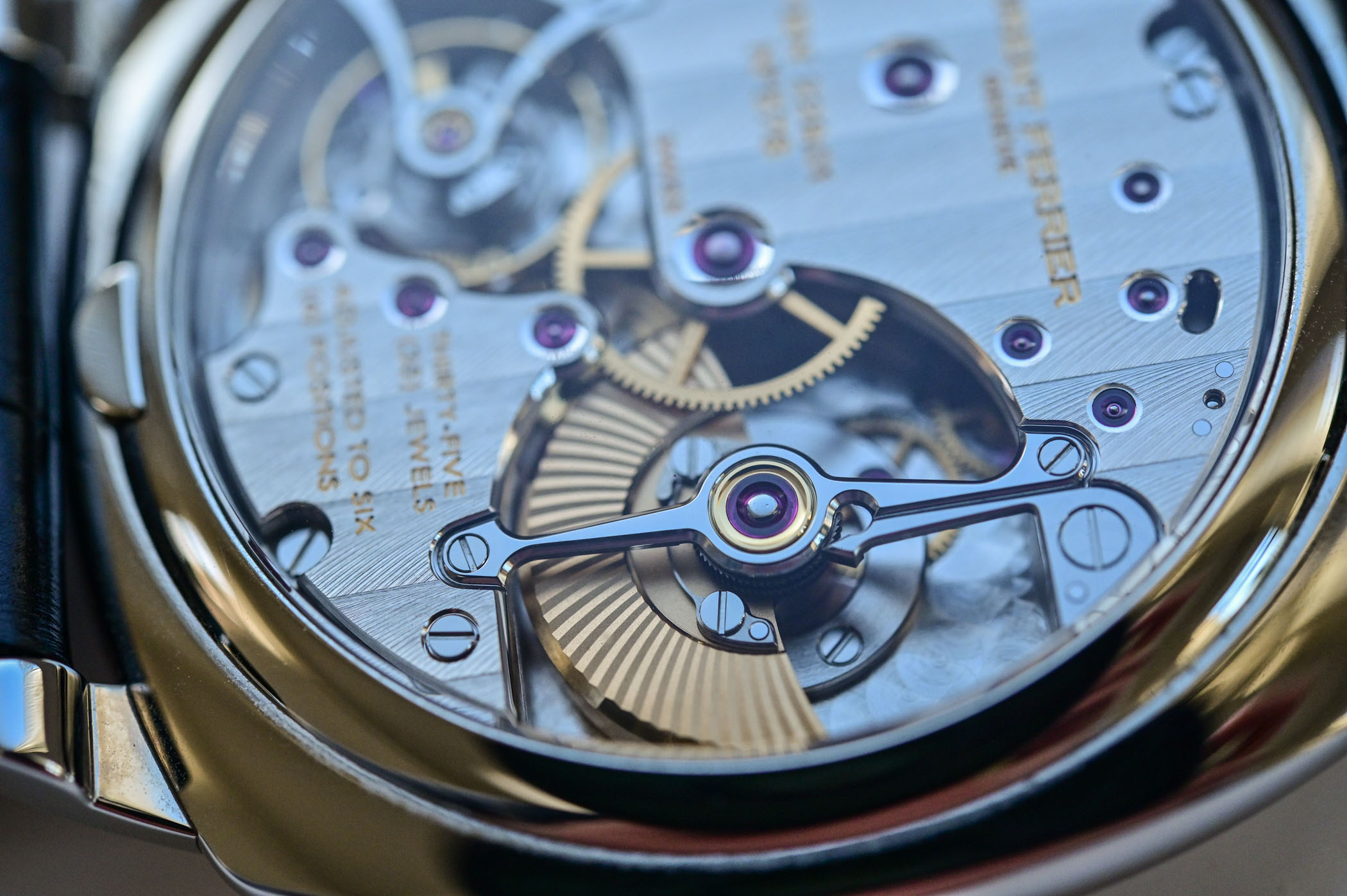
The quest for mechanical slimness has driven haute horlogerie to constantly reinvent how automatic watches harvest kinetic energy from wrist movement. Traditional self-winding mechanisms rely on a heavy central oscillating weight that sweeps across the entire diameter of the movement. While efficient, this architecture blocks the view of hand-finished bridges and adds unnecessary vertical bulk. To achieve ultra-thin profiles without sacrificing self-winding convenience, watchmakers developed two ingenious engineering alternatives: the micro-rotor and the peripheral rotor.
1. The Micro-Rotor Architecture: Space Efficiency Meets Inertial Physics
First popularized in the late 1950s by pioneering manufactures, the micro-rotor embeds a miniaturized oscillating weight—typically fashioned from high-density heavy metals like 22-karat gold, platinum, or tungsten—directly into the plane of the movement bridges rather than hovering above them.
- Inertial Challenges: Because the mass and radius of a micro-rotor are significantly reduced compared to a full-size central rotor, its rotational inertia is lower. According to the laws of rotational motion, torque is proportional to mass multiplied by the square of the radius. A micro-rotor compensates for its smaller radius by utilizing ultra-dense precious metals to maximize mass.
- Aesthetic Integration: Sinking the micro-rotor flush into the movement architecture allows the balance wheel, escapement, Geneva stripes, and bevelled anglage to remain completely unobstructed, offering the wearer an unhindered view of mechanical complexity.
2. Peripheral Oscillating Weights: The Pinnacle of Slimness
Representing the absolute cutting edge of automatic winding design, the peripheral rotor eliminates vertical intrusion entirely by mounting an annular (ring-shaped) weight around the absolute outer perimeter of the movement.
- Friction and Guidance Engineering: Guiding a massive ring smoothly along the circumference of a watch movement requires extreme manufacturing tolerances. Modern peripheral systems utilize microscopic ball bearings, ceramic rollers, or magnetic levitation guides to minimize rotational friction.
- Unobstructed Panorama: With no central post or oscillating bridge covering the movement, a peripheral-rotor watch offers a 360-degree unobstructed panorama of the gear train, mainspring barrel, and regulating organ.
3. Comparative Efficiency and Winding Performance
When evaluating winding efficiency across these three topologies:
- Central Rotors remain the most efficient due to maximum leverage and inertia.
- Micro-Rotors offer an ideal compromise between ultra-slim styling (often under 3mm total movement thickness) and reliable daily power reserve replenishment.
- Peripheral Rotors represent supreme masterworks of watchmaking craftsmanship, though their mechanical complexity makes them exceptionally demanding to service and calibrate. Choosing a movement architecture depends entirely on whether the priority is rugged daily utility or uncompromised ultra-thin architectural purity.
Power Reserve and Torque Delivery
A movement's architecture is ultimately a negotiation between energy storage and stable delivery. Longer power reserves are marketed heavily, but a reserve is only useful if torque remains consistent across the entire discharge of the mainspring. Toward the end of the reserve, declining torque reduces balance amplitude, which subtly degrades rate accuracy — the watch runs measurably differently on day one versus day three. This is why constant-force mechanisms, twin barrels and carefully profiled mainsprings exist: they flatten the torque curve so the escapement receives a steady impulse regardless of wind state. When comparing calibers, look past the headline reserve figure and ask how stable the delivery is across that window.
Servicing Implications of the Architecture
Every design choice a movement makes echoes forward into decades of maintenance. Integrated automatic winding modules, delicate micro-rotors and peripheral bearings each demand specific expertise and, frequently, proprietary tooling. A caliber that is elegant on the wrist may be intricate and costly on the watchmaker's bench, and prospective owners should factor lifetime service accessibility into any acquisition. The most enduring movements balance mechanical ambition against serviceability, ensuring that a watch bought today can still be maintained a generation from now without depending on a single manufacturer's willingness to stock spare parts.
Practical Field Checklist
Before acting on any single specification, seasoned collectors run a disciplined verification pass. First, corroborate the claim against at least two independent primary sources — a manufacturer technical sheet and a respected archival reference — rather than relying on a single retail description. Second, translate the abstract specification into a real-world consequence: ask precisely how a given rating, tolerance or material property changes the way the watch behaves on the wrist across a decade of daily wear. Third, weigh the cost of being wrong. A misjudgement on a purely cosmetic detail is recoverable; a misjudgement on structural integrity, water resistance or movement authenticity can be expensive and, in the case of vintage pieces, irreversible. Building this three-step habit converts passive reading into active expertise, and it is a discipline that pays compounding dividends across an entire collecting lifetime.
Common Misconceptions Worth Correcting
Enthusiast forums perpetuate a surprising number of half-truths, and part of becoming a discerning owner is learning to question inherited wisdom. Marketing language routinely inflates the significance of features that have negligible impact on daily performance, while quietly omitting the genuine engineering trade-offs behind them. A higher number is not automatically better; a heritage name does not guarantee superior execution; and a premium price frequently reflects scarcity, brand positioning or hand-finishing hours rather than measurable functional advantage. The most valuable skill a collector can develop is the ability to separate the objectively measurable from the subjectively marketed — to appreciate craftsmanship for what it genuinely is, without mistaking narrative for physics. When a claim seems too clean or too flattering, it usually conceals a nuance that the disciplined collector takes the time to uncover.
Why This Knowledge Compounds Over Time
Isolated facts are fragile, but a connected mental model is durable. Each principle explored here interlocks with the others: material science informs servicing intervals, movement architecture shapes total cost of ownership, and historical context explains why certain designs command enduring premiums. The collectors who develop true expertise are not those who memorise the most specifications, but those who understand how the pieces relate — how a decision made at the metallurgy stage echoes through decades of maintenance, resale and daily enjoyment. Treat every article, every watch examined and every conversation with a knowledgeable dealer as another node in an expanding web of understanding, and your judgement will sharpen far faster than rote memorisation could ever achieve.
Putting Theory Into Practice
Knowledge only becomes expertise when it is exercised. The next time you handle a watch — whether at an authorized dealer, a collector meet-up or a private viewing — deliberately apply the concepts covered above rather than absorbing the sales narrative passively. Ask the specific technical questions, request to see the movement, examine the finishing under good light, and notice which claims the seller can substantiate and which dissolve under scrutiny. This active, hands-on practice transforms abstract reading into instinctive competence, and it is precisely the process by which casual admirers gradually become the trusted, discerning collectors whose opinions genuinely carry weight within the horological community.
Continue exploring the archive

Materials & Science
Demystifying Modern Watch Crystal Materials: Sapphire vs. Box-Form Hesalite and Advanced Ceramic Composites
An exhaustive analysis of contemporary horological crystal engineering, examining the scratch resistance, optical refraction, impact dynamics, and thermal stability of synthetic sapphire, double-domed hesalite, and newly developed transparent ceramic matrices.

Buying & Investment
Navigating the Secondary Watch Market: Authentication, Liquidity, and Valuation Indices
An expert strategic guide for collectors navigating the pre-owned luxury watch market, covering counterfeit detection, liquidity indexing, box-and-papers premium valuation, and cyclical market trends.

History & Heritage
The Chronology of Horological Innovation: From Verge Escapements to Co-Axial Mastery
A comprehensive historical survey of mechanical watchmaking milestones, detailing the transition from crude 14th-century weight-driven towers to portable pocket watches and modern anti-magnetic wristwatches.